
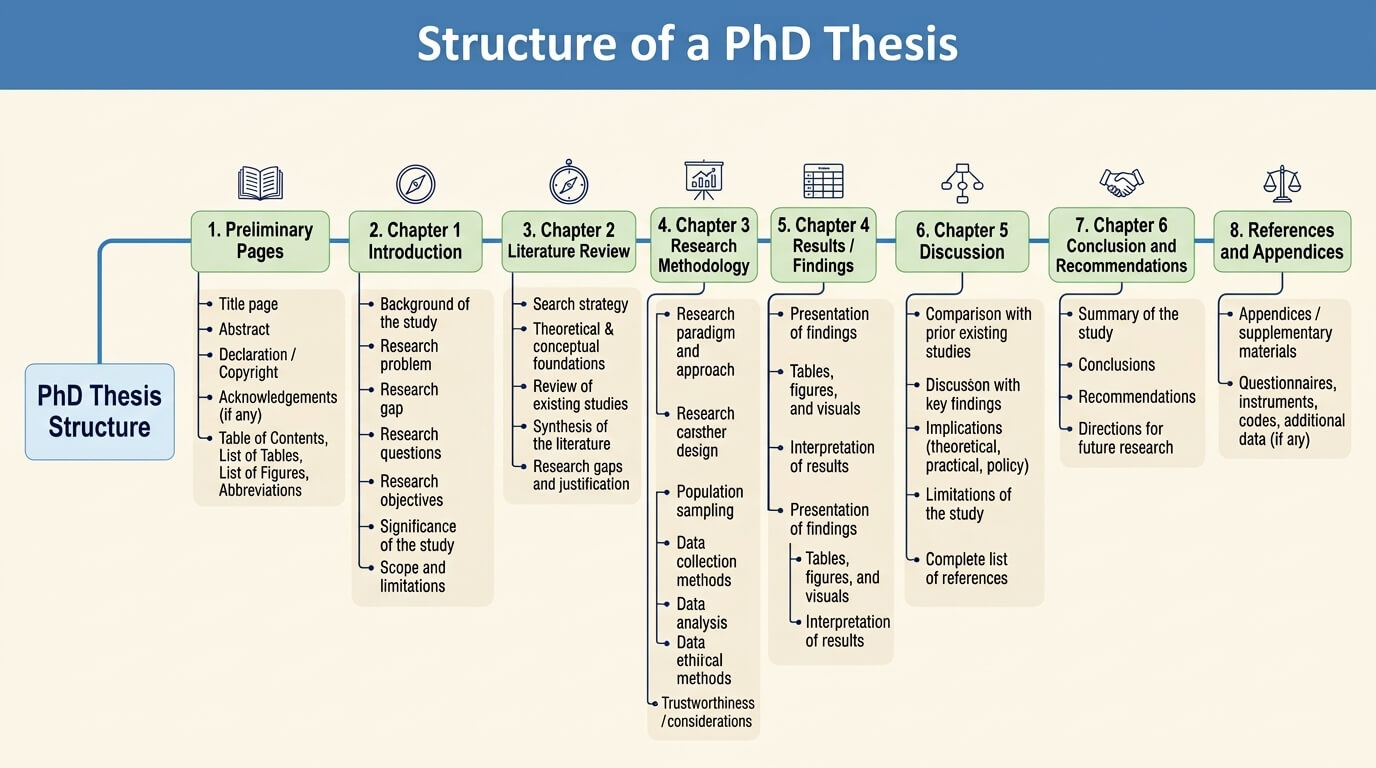
Writing a PhD thesis is a multi-year journey, but organizing its content doesn’t have to be overwhelming. This guide breaks down the core structural components of a standard PhD thesis, with a dedicated mind map for each section.
Note: Exact thesis structures vary by institution, discipline, research design, and university guidelines. Always align your final draft with your faculty’s specific handbook.
Preliminary Pages
The front matter establishes the formal foundation and administrative compliance of the document.
Key elements: Title page, declaration, acknowledgements, abstract, table of contents, list of tables and figures, list of abbreviations.
Abstract
A standalone summary of the entire study, covering the problem, methodology, major findings, and primary contributions.
Chapter 1: Introduction
Establishes the context, scope, and rationale of the doctoral research.
Key elements: Research background, statement of the problem, research gap, research questions, research objectives, significance of the study, scope, and key limitations.
Chapter 2: Literature Review
Demonstrates a critical synthesis of existing knowledge and builds the theoretical foundation of the research.
Key elements: Literature search strategy, theoretical framework, synthesis of existing empirical studies, identification of research gaps, theoretical justification.
Chapter 3: Research Methodology
Details the empirical framework and operational steps taken to answer the research questions.
Key elements: Philosophical paradigm, research design, sampling strategy, data collection instruments, analytical procedures, validity/trustworthiness, ethical considerations.
Chapter 4: Results and Findings
Presents the empirical outcomes of data collection without subjective bias or broad interpretation.
Key elements: Systematic presentation of findings, statistical tables, data visualizations, qualitative themes, key analytical results.
Chapter 5: Discussion
Interprets the findings, connects them to prior literature, and articulates their broader meaning.
Key elements: Interpretation of primary findings, direct comparison with previous research, theoretical and practical implications, study limitations.
Chapter 6: Conclusion and Recommendations
Synthesizes the core contributions of the study and outlines actionable next steps.
Key elements: Executive summary of the research, overarching conclusions, practical recommendations, specific directions for future research.